roofing
Storm & Hail Damage in Canton, GA
Hail damage is often invisible from the ground and frequently invisible from the driveway, which is why the roof that looks fine after a storm is sometimes the one with three years left instead of eighteen. This page explains what hail actually does to a shingle, what wind does differently, and what an adjuster is looking for when they mark a test square. It is about identifying damage. If you already know you are filing, the claims page is the one you want.
If you already know you are filing, start on the claims page instead — this one is about identifying damage, that one is about what happens next.

What we actually do on this job
- Every slope walked and photographed, dated, with the storm date recorded
- Soft metals checked first — gutters, vents, flashing, the AC fins, the mailbox
- A test square chalked and counted the way an adjuster counts it
- Wind damage assessed separately from impact damage, because they document differently
- Interior and attic checked for the water that has already got in
- A written answer that says damage, no damage, or borderline — and what we are basing it on
Damage 1 of 3
Hail: impact, and what a bruise actually is
Hail does not usually punch through a shingle. It knocks the granules off in a circle and it bruises the mat underneath — you can feel a hail hit through the shingle with a thumb before you can reliably see it, which is exactly why a driveway inspection misses them. The granules are the shingle's sunscreen; once they are gone the asphalt starts breaking down under UV, and the roof fails years early rather than immediately. That delay is the whole problem: the damage is real on the day of the storm and the leak is three years later, by which time the storm date is long gone. Across these eight counties, severe hail runs about a quarter of its annual total in April and roughly seven in ten of it between March and June — and the National Weather Service's own local climatology explains why big stones are comparatively rare here: our storms are mostly the pulse type that build with afternoon heating, and "hail is less frequent with these storms because wetbulb zero heights are usually quite high." That is a real mechanism, from the office that forecasts for these counties. It is also why you will not see us borrow the nickname other roofing sites reach for when they describe this market. That nickname belongs to one specific named region where Colorado, Nebraska and Wyoming meet — NOAA's severe-storms laboratory uses it that way and no other — and it is about 1,200 miles from here. Applying it to north Georgia is a geographic error, not an exaggeration, and it is the first thing we struck off this page.
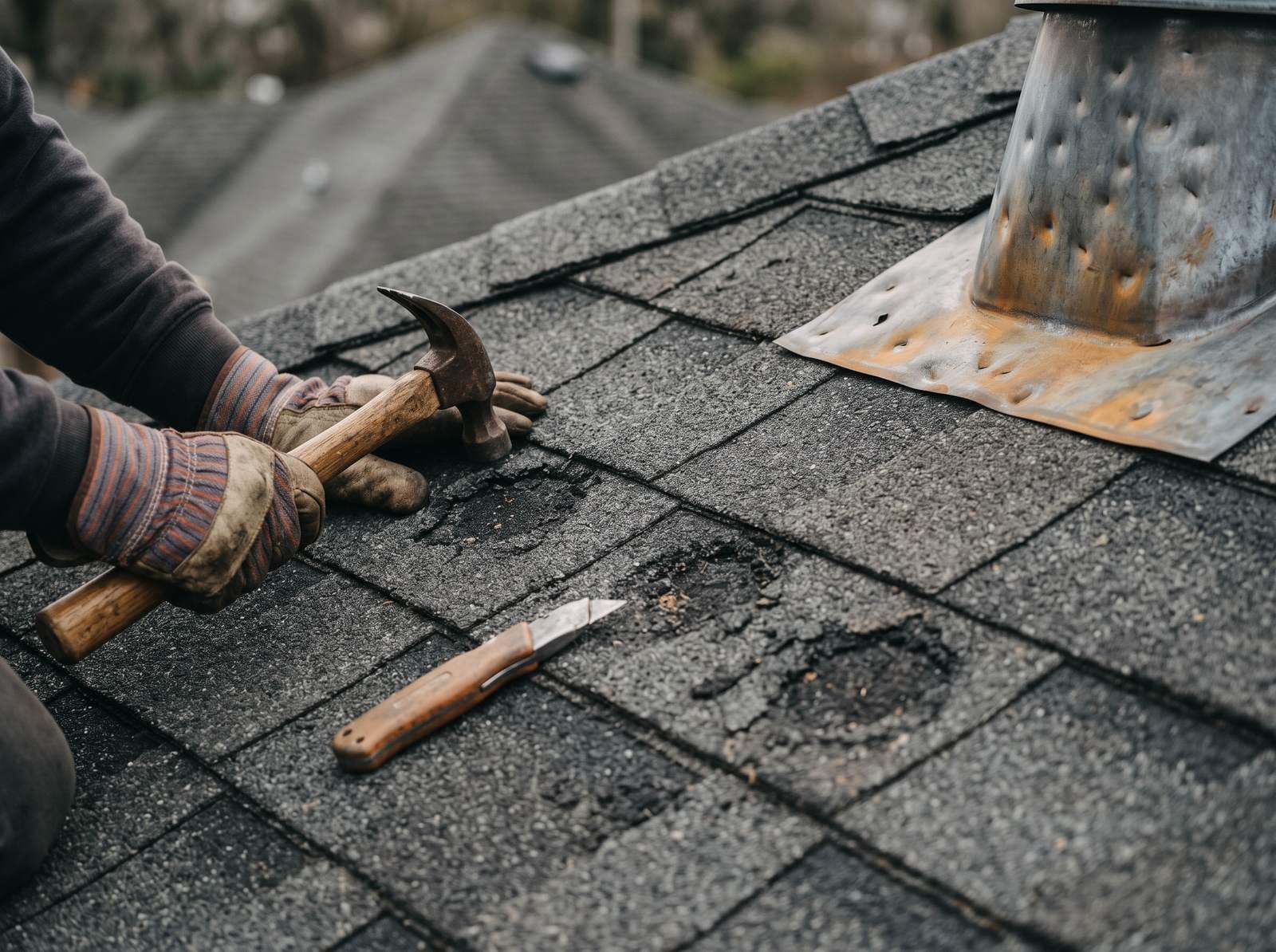
What an adjuster is looking at
- Circular granule loss with a darker, softer mat exposed at the center
- A bruise you can feel with a thumb even where you cannot clearly see it
- Impact marks on soft metals — vent caps, gutter aprons, flashing, window wraps
- Spatter marks on oxidized metal, which date the event
- A count of impacts inside a ten-by-ten test square, per slope
- Whether the marks are directional and consistent with a storm rather than with foot traffic or mechanical damage
Damage 2 of 3
Wind: lifted, creased, and gone
Wind damages a roof in a completely different way and documents differently as a result. It breaks the seal strip and lifts a tab, which leaves a crease across the shingle that stays there after the tab lies back down — so a roof can look intact from the ground and be full of shingles that will no longer reseal. Where it takes shingles off entirely the damage is obvious; where it has only broken the seal it is not, and that is the more common case. Across this region damaging wind is roughly twice as common as hail in the event record and it peaks in July rather than in April. And in wooded north Georgia the wind's usual route into your house is not the wind at all: text-mining every one of the 1,813 wind-event narratives in the eight-county record, 85% mention trees or limbs and 14% explicitly describe a tree falling on a structure or a vehicle. A tree strike is a single-point impact with structural consequences, and it is a different scope, a different set of photographs and a different conversation from a hail claim.
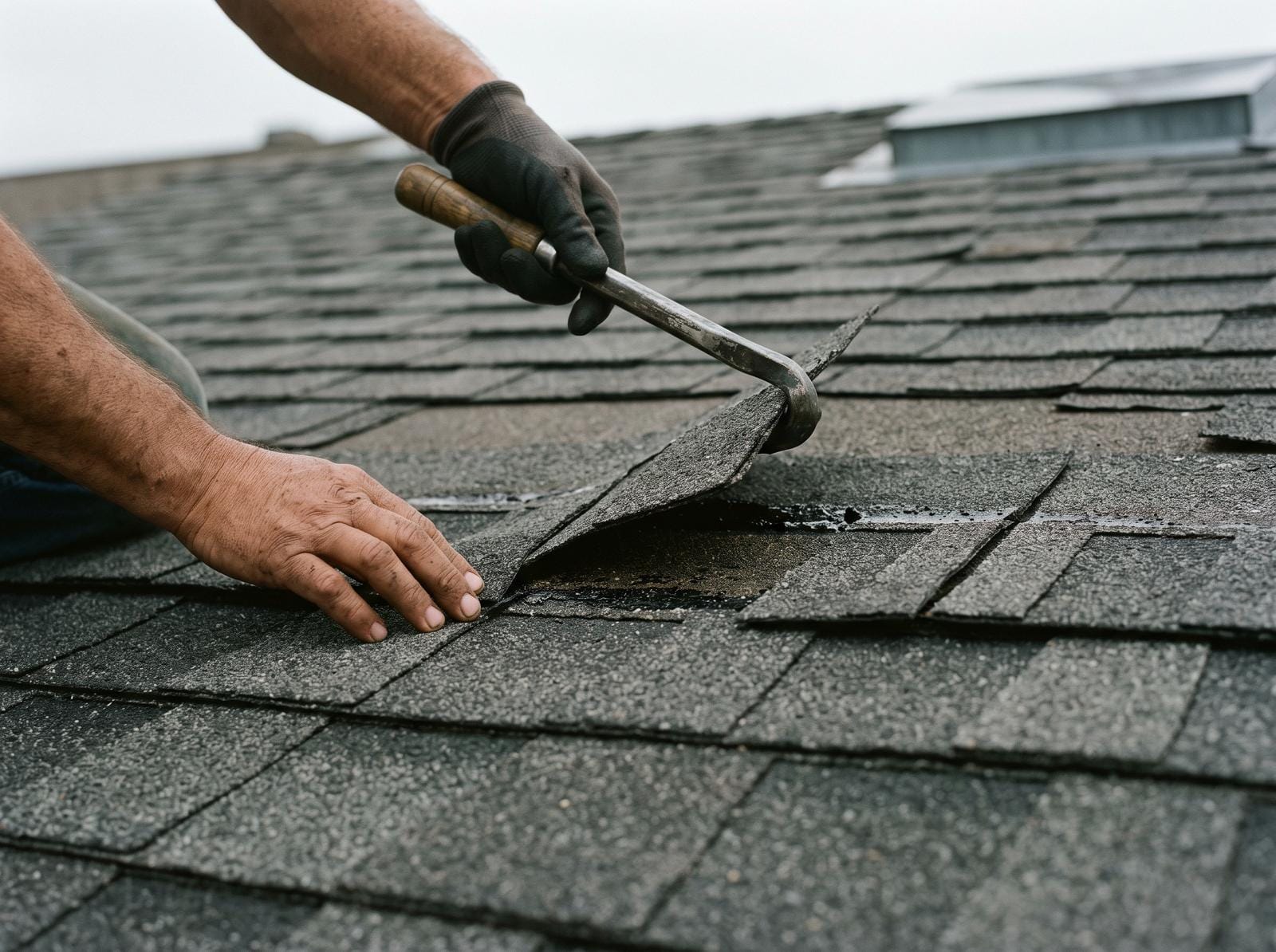
What an adjuster is looking at
- Creased tabs — the fold line that remains after a lifted shingle drops back
- Broken seal strips, checked by hand rather than by eye
- Missing shingles, and whether the pattern is directional
- Damage concentrated on the windward slope and at ridges, rakes and eaves
- Torn or displaced underlayment where shingles have gone
- For a tree strike: the point of impact, the decking beneath it, and the framing
Damage 3 of 3
Water and the aftermath
The damage that costs the most is usually the damage that arrives afterwards. Once the shingle layer is compromised, wind-driven rain gets to the underlayment and then to the deck, and the first thing you see is a stain on a ceiling somewhere that is not under the hole — water travels along rafters and down framing before it drops. In north Georgia the ice pathway matters too: 93% of ice-storm events in the thirty-year record mention tree or limb damage, and Pickens County records more ice-storm, heavy-snow and winter-storm days than any of its seven neighbors. If you have water coming in now, the first job is a tarp and a dry-in, not an estimate. We will do that first and talk about the rest afterwards.

What an adjuster is looking at
- Staining on the underside of the deck and along rafters in the attic
- Wet or delaminated sheathing, and where it is relative to the roof damage
- Insulation that has been saturated and has not dried
- Interior ceiling and wall damage, photographed with the date
- Whether an emergency tarp or dry-in was carried out, and when
How it goes
01
Start on the ground
Soft metals bruise before shingles do. Gutters, downspouts, vent caps, flashing, window wraps and air-conditioner fins tell you whether stones of a damaging size actually fell here before anyone climbs anything.
02
Walk every slope
Hail is directional. A north slope can be untouched while the west slope is covered. A report that looked at one slope is not a report.
03
Chalk a test square and count it
A ten-by-ten-foot square, marked out, with every impact inside it circled and counted. It is what an adjuster does and it is the only way to turn "there are some marks" into a number two people can look at together.
The neighbor's roofer says we all have damage. Do we?
Maybe, and it is worth having somebody look. But "the whole street has damage" is a sales line before it is a finding, and a roof two doors down can have a different exposure, a different age of shingle and a different slope facing the storm. We will chalk a test square on your roof and count what is in it, and if the count does not support a claim we will tell you that — which is the part that separates an inspection from a pitch. What we will never do is tell you what your carrier will decide. Nobody standing on your roof can know that.
Questions about storm & hail damage
How long after a storm should I have the roof looked at?
Soon, and we are deliberately not going to put a number of days on that, because your policy's notice provisions are terms of your contract and telling you what they are would be advising you on it. What we can say is that policies carry prompt-notice provisions, that they are usually shorter than people expect, and that an inspection is free and takes forty-five minutes. Read your policy or ask your agent.Can you tell if there is damage from the ground?
No, and neither can anyone else. Hail bruises the mat under the granule layer and you often have to feel it with a thumb to be sure. A report written from the driveway is a guess. That is the single most useful thing anybody can tell you about hail.What is a test square?
A ten-foot by ten-foot area chalked out on a slope, with every impact inside it circled and counted. Adjusters use it to turn a subjective look into a number, and we do the same thing so that when your adjuster marks one we are looking at the same roof in the same way.Does a free inspection start a claim?
No. It is an inspection. It does not open a claim, does not notify your carrier and does not obligate you to file. Whether to file is your decision and your agent's — we can tell you what we see on the roof and nothing more than that.Do storm repairs need a permit?
A full replacement generally does; an emergency tarp does not. Permits are entirely a local question in Georgia because the state deletes the permit chapter of the residential code, so the answer differs across the counties we work in and we get it in writing before the material arrives.
Free inspection
Request an inspection window
Three steps — four if there has been a storm. About ninety seconds.
Working out what happens after the inspection? The claims page walks through the whole sequence, including the two steps that only apply if you file.

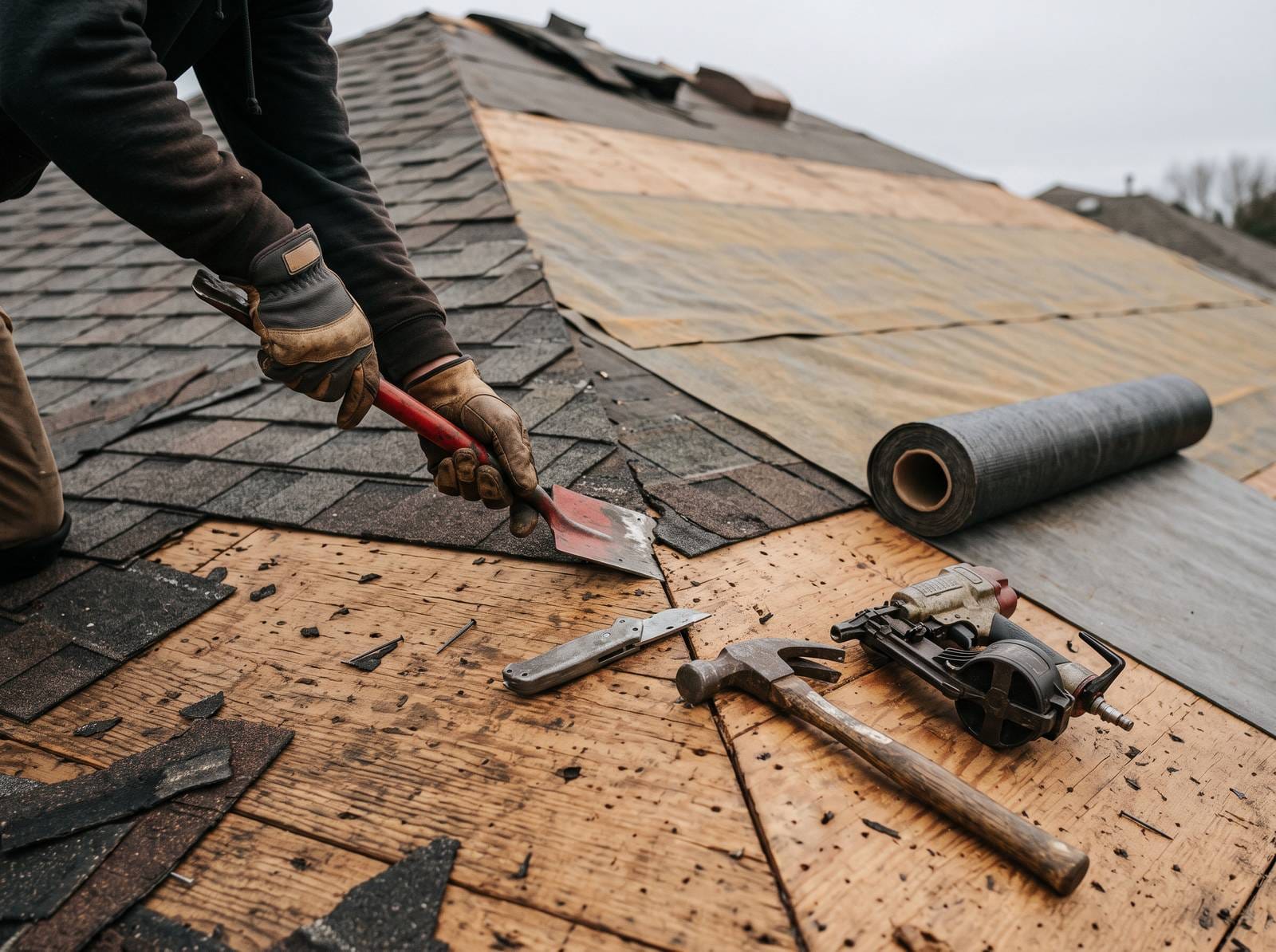
Get on the roof and know for sure.
Forty-five minutes, dated photographs, a written answer, and no obligation of any kind.